
3 Ways to Decrease Workplace Stress
Every month, Aha! Leadership publishes one idea designed to make you a better leader. This month: why workplace stress is a leadership problem before it is a staffing problem.

In the Room
A senior director at a regional healthcare network calls it "the fog." His team has been through two rounds of restructuring, a technology migration, and a return-to-office reversal inside of eighteen months. Everyone is still showing up. The work is getting done. But something is off. Conversations are shorter. Decisions that used to take a day are taking a week. Nobody pushes back on anything anymore. He is not sure if he has a stress problem or a morale problem or a performance problem. He is not sure those are three different things.
Stress at work does not always announce itself. It does not always look like someone breaking down in a conference room or submitting a resignation letter with a long explanation. More often it looks like the director's team above: people who are technically still there but operating at a fraction of what they are capable of, making smaller decisions, taking fewer risks, and staying quiet in the rooms where they used to have opinions.
Leaders misread this constantly. They see compliance and call it stability. They see reduced conflict and call it cohesion. Meanwhile the actual cause, accumulated, unaddressed stress, is quietly draining the performance they are trying to protect.
Workplace stress is not primarily an HR problem or a benefits problem or a staffing problem. It is a leadership problem. Not because leaders cause all of it, but because leaders are the single most influential variable in whether their people experience stress as manageable or as something to survive. And most leaders have never been taught what to actually do about it.
Here are three things that work.
The Real Problem: Stress Is a Signal, and Leaders Keep Missing It
Stress in the workplace has a well-documented relationship with productivity. When stress exceeds a person's ability to manage it, output drops, decision quality declines, and the instinct to collaborate gives way to the instinct to protect. This is not a personality failure. It is basic human neurology. A brain that is managing a sustained threat response does not have full access to the higher-order thinking that most knowledge work requires.
The problem is that the visible signs of this tend to appear late. By the time a leader notices disengagement, conflict, or turnover, the stress driving those outcomes has usually been accumulating for months. The early signals, quieter meetings, slower decisions, people who stop volunteering for things they used to pursue, are easy to attribute to workload or personality rather than to a culture problem the leader has the power to address.
Three patterns show up consistently in teams operating under high chronic stress. The first is constant change without adequate context. When people experience repeated disruptions without understanding why the changes are happening or what they mean for their role, the brain fills the gap with anxiety. The second is role overload, specifically being asked to carry responsibilities in areas where people feel underprepared. Competence gaps under pressure are a significant stress accelerant. The third is lack of clarity about expectations. When people are unsure what success looks like or how their performance is being evaluated, the uncertainty itself becomes the stressor.
None of these are inevitable. All three are within a leader's sphere of influence.
Why It Keeps Happening: Leaders Are Often the Last to Know
There is a structural reason leaders are frequently the last to recognize stress in their teams: the people experiencing it often do not tell them.
This is not conspiracy. It is self-preservation. Employees in high-stress environments have usually learned, through observation if not direct experience, that raising concerns about workload, clarity, or pace carries social risk. The person who says "this is too much" is more likely to be seen as the problem than the workload. So people cope privately, perform publicly, and the leader operating on visible signals concludes that things are under control.
This is the same mechanism that produces the "everyone seemed fine until they quit" phenomenon. Nobody seemed fine to their colleagues. The leader was simply not receiving accurate information because the environment was not safe enough to produce it.
There is a harder dynamic underneath this. Many leaders who came up through demanding environments have a calibrated tolerance for stress that is significantly higher than their team's. What feels like a challenging-but-manageable period to a leader can feel unsustainable to the people working under them. This gap in perception is not a weakness in the team. It is a data point about how the leader is reading the room.
The leaders who consistently maintain high-performing teams are not the ones who prevent every difficult period. They are the ones who stay close enough to their people to know when difficult has crossed into unsustainable, and who act on that before it becomes a retention problem.
What It Actually Takes: 3 Ways to Decrease Workplace Stress
These are not morale initiatives. They are operational behaviors that, when practiced consistently, change the stress experience of the people working for you.
1. Give people enough context to stop filling in the blanks.
The single most underestimated driver of workplace stress is uncertainty. Not difficulty. Not workload. Uncertainty. When people do not know why a decision was made, what it means for their team, or what is coming next, they manufacture answers. And manufactured answers are almost always worse than the truth.
Leaders who communicate change with genuine transparency, naming what they know, acknowledging what they do not know, and explaining the reasoning behind decisions even when the decision is unpopular, give their teams something to work with. That is not spin. It is respect. And it measurably reduces the ambient anxiety that drains performance.
This does not require a communication strategy or a town hall. It requires a consistent habit: before you move on from a significant decision or change, ask yourself what your team does not know yet that they need to. Then tell them.
2. Audit the load before you add to it.
Most leaders who manage overloaded teams did not create the overload intentionally. They approved projects one at a time, each of which seemed reasonable in isolation. The cumulative weight is invisible until someone breaks under it.
Build the habit of reviewing total workload, not just individual tasks, before adding new responsibilities to your team. When restructuring or upskilling creates new demands, be explicit about what comes off the list to make room. "Here is what we are adding and here is what we are pausing or stopping" is a fundamentally different message than "here is everything we need to do now." The first one respects your team's capacity. The second one ignores it.
When the actual answer is that the team is under-resourced and the work genuinely exceeds what the current headcount can carry well, say so directly and advocate for the staffing your team needs. That conversation is harder than managing the symptoms. It is also the only one that solves the actual problem.
3. Make it safe to say when something is not working.
The most efficient stress-reduction tool available to any leader is a team that tells them early when something is off. Not a team that silently absorbs problems until they become crises.
Building that team requires a specific kind of consistent behavior from the leader. When someone surfaces a problem, the response in the room teaches the rest of the team what happens when problems are surfaced. A leader who responds with curiosity and problem-solving creates a different incentive than a leader who responds with frustration or who pivots immediately to finding someone to blame.
This does not mean every problem gets solved instantly or that every concern is valid. It means the act of raising a concern is treated as useful rather than inconvenient. That distinction is entirely within the leader's control and it is the foundation that every other stress-reduction effort depends on.
The Harder Truth: You Cannot Manage Your Way Around Culture
There are leaders who implement all three of the above behaviors and still lead teams with high chronic stress. Not because the behaviors do not work, but because the culture above them is producing stressors faster than their individual actions can absorb.
This is a real constraint. A team leader in an organization that churns through strategic pivots every quarter, communicates layoffs with no warning, and treats headcount as the primary cost-reduction lever is operating inside a system that generates stress structurally. Individual leadership behavior can buffer that impact. It cannot eliminate it.
The honest version of this conversation acknowledges that some of what employees are experiencing is not a leadership problem at a team level. It is an organizational design problem. The fix is not more manager training. It is executives who build cultures with enough stability, clarity, and resourcing that people can do their best work over time, not just in peak performance windows.
If you are a senior leader reading this, that accountability sits with you. The leaders below you are managing the consequences of the environment you build. How much of their capacity is going toward doing their actual work, and how much is going toward managing the instability you have designed into the system?
Frequently Asked Questions
-
Look for behavioral changes, not just output metrics. A team under normal productive pressure is still engaged in meetings, still bringing ideas, still willing to push back. A team under performance-affecting stress gets quieter. Decisions slow down. Conflict either disappears completely, which usually means it has gone underground, or spikes unpredictably. If your team is hitting targets but the energy in the room has changed, investigate the energy.
-
Stop asking "Are you doing okay?" It is a question with a socially expected answer. Instead ask specific operational questions: "What is the hardest part of your role right now?" "What would make the work easier?" "What are we asking you to carry that you don't feel ready for?" These questions invite a specific answer rather than a status update and tend to surface real information. Also watch what people do when they think you are not evaluating them. Behavior in informal settings is often more honest than behavior in a 1:1.
-
Some amount of challenge and urgency drives performance. That is well established. The relevant question is duration and intensity. Short-term pressure toward a clear goal with adequate support is different from sustained uncertainty with no relief. Most people who describe themselves as performing well under pressure are doing so in bursts, not continuously. When sustained high pressure becomes the baseline, the performance gains erode and the health and retention costs accumulate. The goal is not to eliminate pressure. It is to make it purposeful and bounded.
-
Name it. Literally. Tell your team that you are aware the current period is difficult and that you see it. Leaders who acknowledge the reality their teams are living in, even when they cannot change it, create a different experience than leaders who project optimism onto a situation that does not warrant it. Your team does not need you to pretend everything is fine. They need to know you are paying attention and that their experience is real to you. That alone changes the stress equation more than most leaders expect.
The Aha! Moment
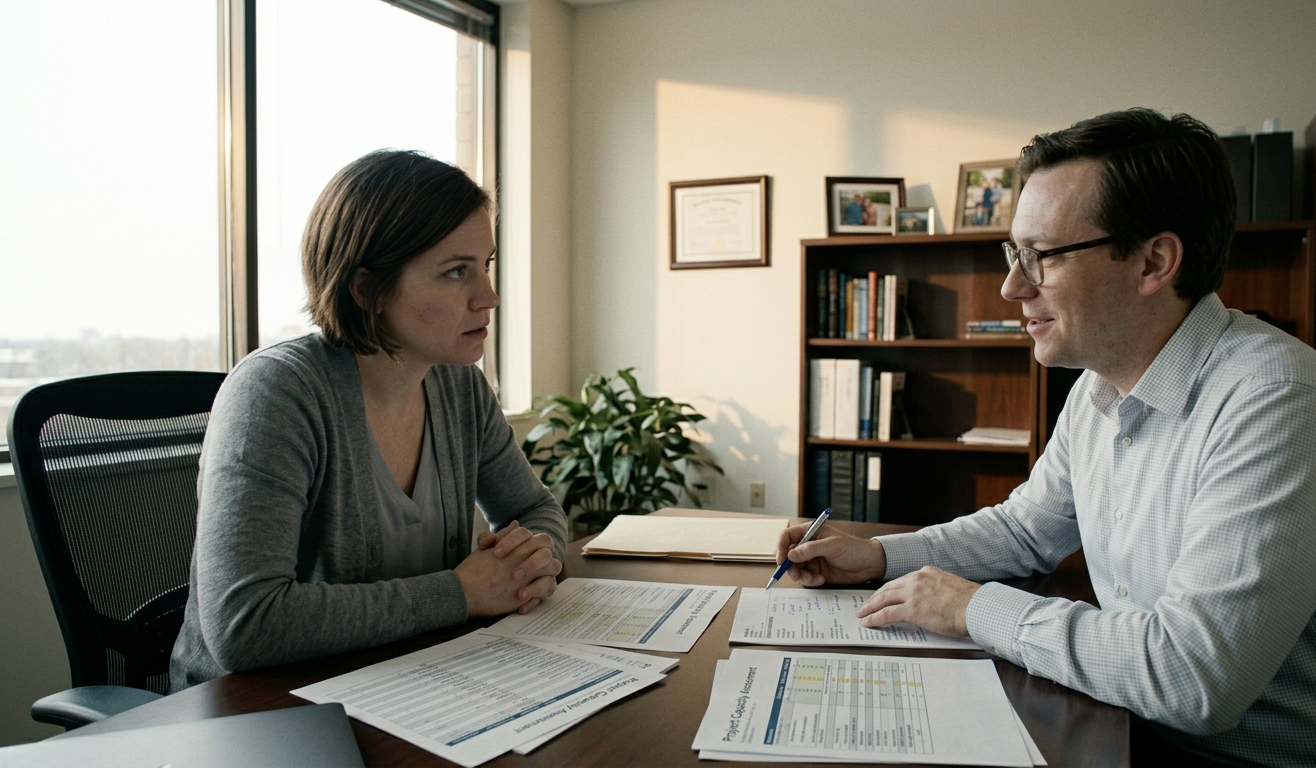
The director with the fog problem eventually figured out what was happening. Not with a survey or a restructuring. He started ending his weekly team meetings with one question: "What is getting in your way right now that I should know about?"
The first two weeks, nobody said anything. The third week, someone mentioned a process bottleneck that had been slowing the team down for four months. He fixed it in two days. The week after that, someone else mentioned a communication gap with another department. He made one phone call.
The fog started to lift. Not because the work got easier. Because the team stopped carrying problems alone.
Stress is not primarily a workload problem. It is a signal problem. When the environment makes it safe to name what is hard, the hard things get addressed before they compound. When it is not safe, they accumulate silently until the team the director thought he had turns into something he no longer recognizes.
You do not manage stress out of a team. You build the conditions where it does not have to hide.

The manager who is quietly costing you your best people probably doesn't know they're doing it.
Do you?
15 questions. Instant results. Free.